Why We Built Stamp Fly
Stamp Fly: A $50 Open-Source Drone Co-Created in Shenzhen and Japan
Why We Built Stamp Fly
Professor Kohei Ito from Kanazawa Institute of Technology was searching for a programmable drone that could be used in the classroom. Existing products were either too fragile, too expensive, or closed-source. The team at M5Stack had previously attempted to launch a drone kit called Atom Fly — but it fell short in durability and functionality.
What Went Wrong with Atom Fly
The original Atom Fly had a lightweight frame made from PCB material, which cracked easily in test flights. The microcontroller, ATOM Lite, lacked enough I/O pins for sensor expansion. Attempts were made to reinforce the frame and improve firmware, but the platform couldn’t handle reliable, repeatable flight — especially in an educational setting.
How Japan Revived the Project
Japanese hardware hacker GOROman prototyped a hybrid: Atom Fly’s electronics inside a BETAFPV 65mm drone frame — a major upgrade in durability. Simultaneously, M5Stack released the M5Stamp S3, a smaller and more powerful board that enabled easier sensor integration. Professor Ito contributed deep expertise in flight control, and the firmware was made open-source to allow further development. Together, Japanese engineers and Shenzhen suppliers collaborated at startup speed to bring the kit to life.
Inside the Stamp Fly Hardware
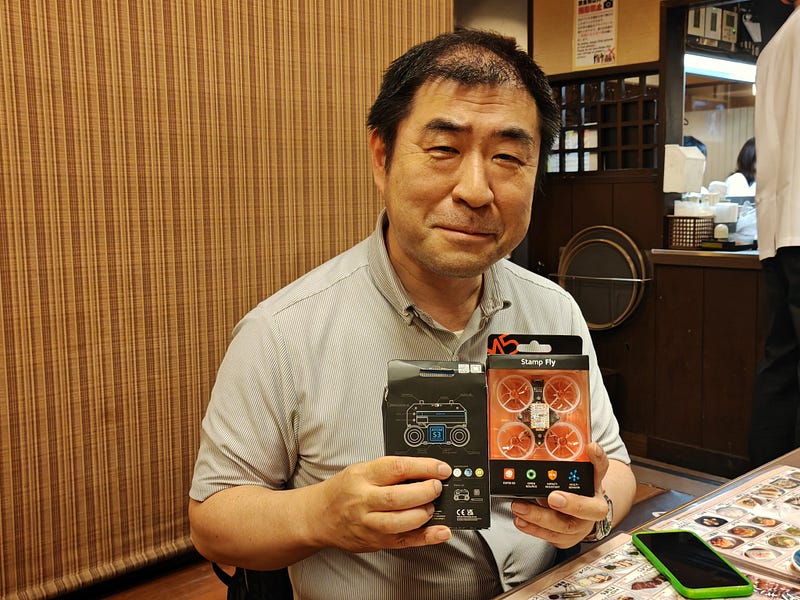
Stamp Fly is powered by the ESP32-S3-based M5Stamp S3, paired with brushless motors, BETAFPV propellers, and a LAVA 1S battery. It connects via the M5ATOM Joystick — a custom-built controller with a screen that shows battery level and pairing status. And yes, even the controller is fully programmable.
Where It’s Being Used Now
Stamp Fly is now used in intensive five-day university classes to teach flight control and PID tuning. It’s also catching attention from the ArduPilot community and DIY drone builders. The kit is fully open-source, from firmware to PCB design, allowing remixing and deep learning.
The Value of Cross-Border Open Hardware
This project is a success story of hardware made fast in Shenzhen and refined by Japanese engineering. It shows how open-source principles and international maker culture can create real, scalable educational tools.
Links and How to Get Involved
Want to build or remix your own Stamp Fly?
📄 Hackster.io project: https://www.hackster.io/stampfly/stamp-fly-an-open-source-diy-drone-kit-from-japan-shenzhen-93d099
🔧 Source files: https://github.com/M5Fly-kanazawa/M5StampFly
M5Stack - Modular Rapid ESP32 IoT Development Board - ESP32 dev
kits
*Open-source modular toolkits for IoT devices based on ESP32-updated
version of ESP8266. With stackable
modules…*m5stack.com{.markup–anchor
.markup–mixtapeEmbed-anchor}
🏫 Interested in using Stamp Fly in your class or workshop? Let’s
connect!
Let’s fly, hack, and learn together. #Shenzhen #OpenHardware #Drone #STEM #Japan #ESP32 #IoT #MakerMovement
By TAKASU Masakazu/高須正和{.p-author .h-card} on April 29, 2025.
Canonical link Exported from Medium on February 6, 2026.