In April 2026, I went to Beijing to watch the Humanoid Robot Half Marathon. I visited the event with members of Scramble, a Japanese organization supporting the next generation of robotics engineers, and other people interested in robotics and China’s technology scene.
This was the second edition of the event. The first one had around 20 teams, with only 5 teams finishing. This time, around 100 teams participated, and 49 teams finished. That change alone says a lot about the speed of development around humanoid robots in China.
But what I saw on the ground was not just a story about faster robots. It was a public experiment: humanoid robots running on the same road as human runners, in front of ordinary spectators, with all their strengths and weaknesses visible.
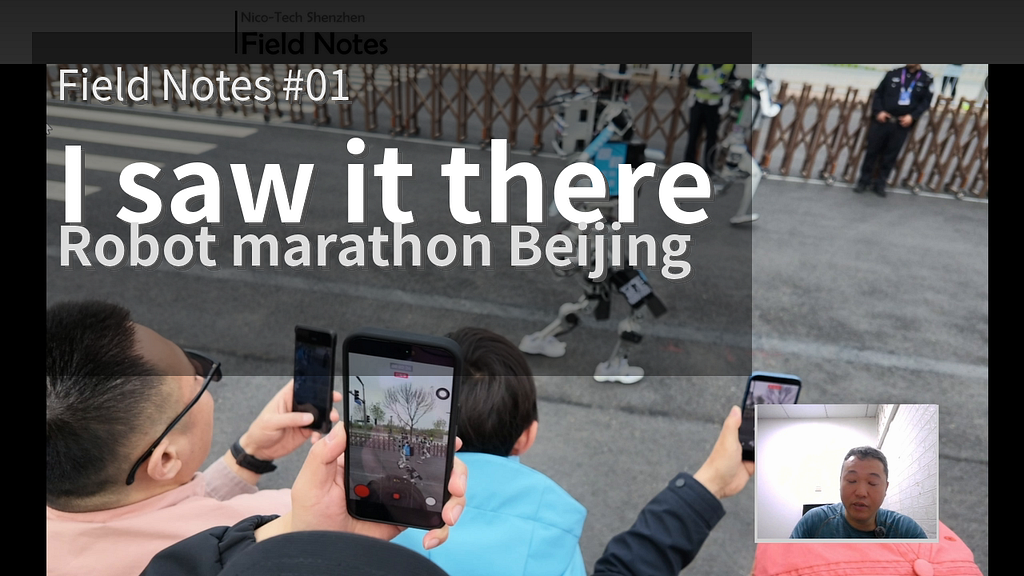
Humans and robots on the same courseThe course was more than 20 kilometers long. The road was divided into two lanes: one for human runners and one for robots. Along the route, people stood on both sides of the road, taking photos and videos whenever a robot passed by.
This made the event feel very different from a trade show or a polished demo video. At a trade show, a company can show only the best moment. In a marathon, the robot has to keep moving outdoors, for a long time, in front of many people. If it stops, overheats, loses balance, or needs maintenance, everyone can see it.
There were also rest areas for robots. Teams could change batteries and do maintenance at designated points. If they repaired or replaced a robot outside those areas, they received a time penalty. Each robot also had support vehicles and judges following it. With 100 teams, the event was not only a robotics competition, but also a large-scale operation experiment.
That was one of the most interesting parts for me. Running a humanoid robot for 21.5 kilometers is not only about the robot body. It also requires batteries, cooling, maintenance, safety rules, support staff, vehicles, judges, and a way to separate robots from human runners. The event showed the whole system around the robot.Autonomy, remote control, and the real difficulty of outdoor runningThe robots could participate either autonomously or by remote control. However, remote-controlled robots received a 20% time penalty. This rule was practical. If the organizers required full autonomy, many teams would not be able to join. If remote control had no penalty, the event would not push teams toward autonomy. The rule created a middle ground.
Many teams added sensors for autonomous running: BeiDou satellite positioning, RTK, LiDAR, cameras, and 3D sensors. These sensors make the robot heavier, but they also allow the robot to recognize its location and environment. According to what I saw, a significant number of teams were trying autonomous running, and some autonomous robots completed the race.
Still, outdoor autonomy is hard. It is not enough to know the robot’s position by GPS or RTK. The robot also needs to deal with other robots, obstacles, turns, narrow paths, and unexpected situations. The final part of the course, inside a park-like area, looked especially difficult. A humanoid robot also shakes while walking or running, so stable perception is harder than it looks.
This is why the event was valuable. It exposed the real problems that do not appear in short indoor demonstrations.Honor, Unitree, Tiangong, and many different approachesOne of the biggest stories of the race was Honor’s robot, “Lightning.” Honor is known as a smartphone company, so seeing its robot become the fastest was impressive. Because it was remotely controlled, a time penalty was added, but on the ground it was clearly one of the most noticeable robots.
What interested me was that Honor seemed to bring strengths from the smartphone industry: batteries, materials, cooling, lightweight design, sensors, and integration. Humanoid robots may look like a completely different industry, but many of the component technologies overlap with smartphones, EVs, drones, and other hardware fields.
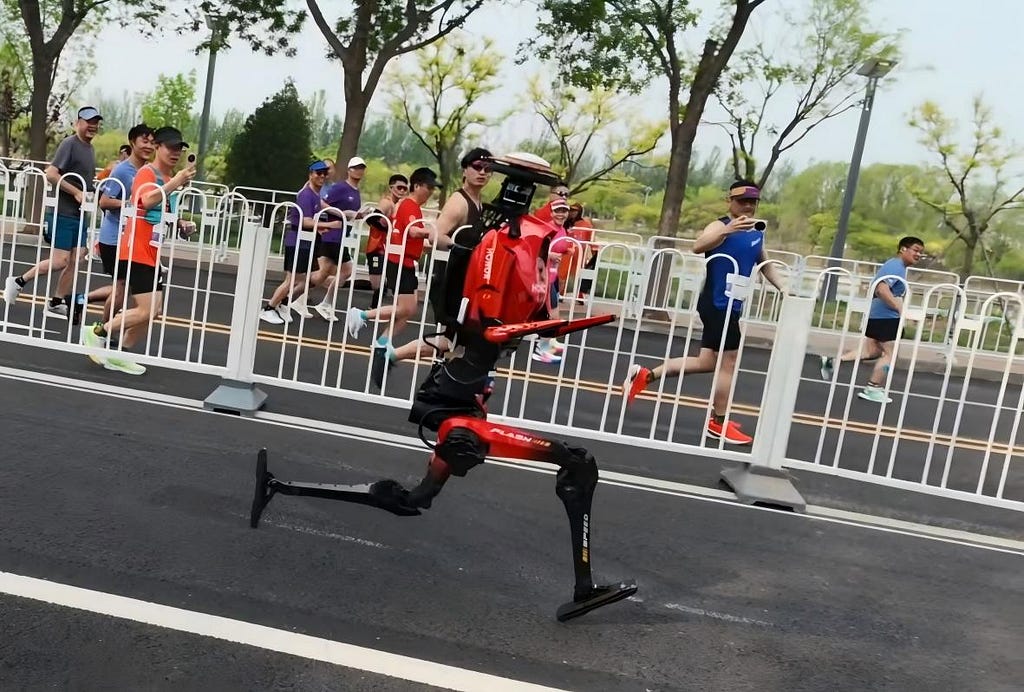
Other teams took very different approaches. Some used Unitree-based robots. Some robots wore human-like running shoes. Some had ski-like feet. Some used dry ice or liquid cooling. Some carried cooling systems on their backs and ran in a forward-leaning posture.
There is no single correct design yet. That is what makes this stage interesting. Each team is testing different assumptions about feet, cooling, sensors, batteries, body balance, and control methods. Instead of watching a finished product, we were watching many experiments happening in public.Robots becoming visible in societyThe most memorable part was not only the robots, but how people reacted to them. Human runners took photos as robots passed by. Spectators cheered, laughed, and watched closely when a robot slowed down or looked unstable.
This matters. For robots to enter society, technical performance is not enough. People also need to see them, react to them, get used to them, and understand both their potential and their limitations.
In Japan, humanoid robots are often discussed through ideas of danger, war, or future anxiety. But when ordinary runners and spectators see robots running next to them, the feeling changes. The robot is no longer only a science-fiction object or a corporate press release. It becomes something present in public space.
Of course, humanoid robots are not yet ready to work everywhere in daily life. Walking, running, turning, stopping, avoiding obstacles, cooling the motors, lasting long enough on battery, and operating safely around people are all still difficult. The previous day, I also saw obstacle challenges with university teams, and those showed how hard humanoid robotics still is.
But that is exactly why this event was meaningful. It did not hide the unfinished state of the technology. It showed it in public.A field report from an unfinished futureThe Beijing Humanoid Robot Half Marathon was not a demonstration of a completed future. It was a field test of an unfinished one.
Some robots were fast. Some were unstable. Some needed maintenance. Some were autonomous, while others were remotely controlled. Some looked advanced, while others looked like experimental machines built around very specific ideas.
But all of them were running in front of people, on real roads, in the same event as human runners.
That is why I found the event important. It showed not only the current state of humanoid robot technology, but also how robots may gradually become part of public life. Before robots can work in factories, stores, homes, or cities, people need to see them in real environments. They need to see what works, what fails, and what still feels strange.
This video is a field note from Beijing: what I saw, how the event was organized, what the robots could and could not do, and why this kind of public robotics event matters.
Watch the video here: